
Sector – Education
Location: Tynecastle High School, Edinburgh
Project Reference: AHU Replacement – Education
Completion: August 2025
Site – Edinburgh Schools District, Scotland
Scope – Full AHU9 replacement including decommissioning, installation, and commissioning
Duration – August 2025
Services – Mechanical, Electrical, Controls Integration
Safety – CDM-compliant delivery with approved lift plan
Outcome – Enhanced air quality, system efficiency, and lifecycle performance
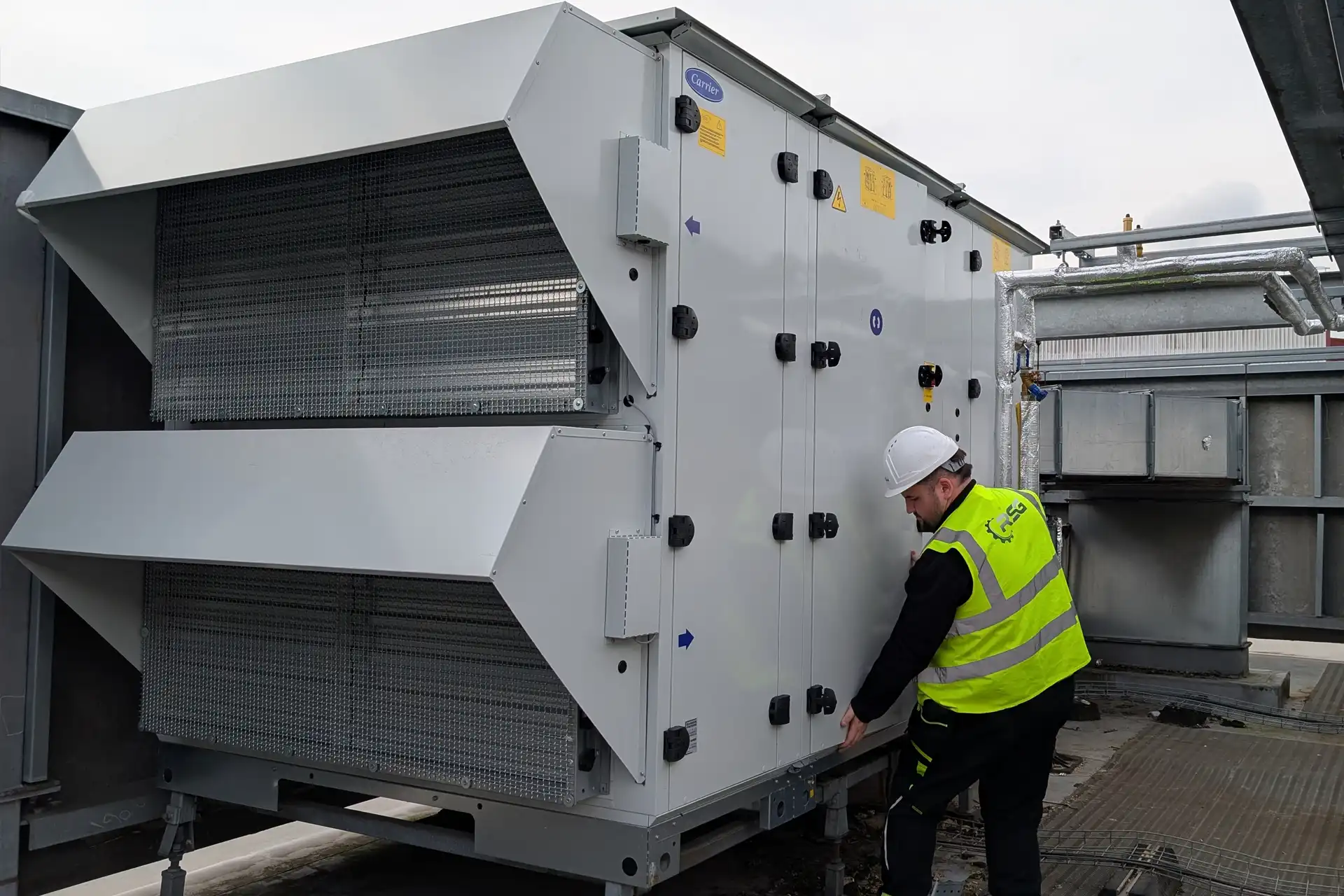
RSG Building Services was engaged to undertake the full replacement of Air Handling Unit 9 (AHU9) at a High School in the Edinburgh School District.
The project formed part of the school’s long-term asset lifecycle renewal programme, designed to sustain optimal air quality and energy performance across the campus.
The scope presented significant logistical and safety challenges. The existing AHU was located within a restricted plant area, requiring careful decommissioning, sectional dismantling, and coordinated crane lifting operations to remove the unit safely from site.
Installation of the new modular AHU demanded precise alignment with existing ductwork, pipework, and control systems to ensure full mechanical and electrical integration. All works were
completed during the school’s summer closure period, enabling RSG to deliver the project efficiently with zero disruption to teaching operations or building services.
This project demonstrates RSG’s capability to execute high-risk mechanical replacement works safely and efficiently, while maintaining full compliance with client and site-specific governance standards.
Due to the nature of the works, health and safety management was a critical focus throughout the project.
Activities included crane lifting, working at height, confined space access, and simultaneous mechanical and electrical operations.
All works were carried out under RSG’s internal CDM-compliant safety framework, with detailed task-specific Risk Assessments and Method Statements (RAMS) developed in coordination with onsite management team.
The crane lift was executed under the control of a qualified Appointed Person and certified banksman, following an approved lift plan reviewed by both RSG and Clients SHEQ teams.
Isolation, lock-off, and permit-to-work systems were applied to all electrical and mechanical interfaces to ensure complete safety during the decommissioning phase.
Pre-start briefings and toolbox talks were delivered daily to the project team, with ongoing supervision from RSG’s site supervisor and SHEQ lead.
All project phases were completed incident-free, achieving full client sign-off and demonstrating RSG’s robust approach to high-risk mechanical replacement works.
The project was successfully delivered on schedule, within budget, and to full client satisfaction.
Following mechanical and BMS commissioning, the new Air Handling Unit achieved verified airflow rates, pressure balance, and energy efficiency performance in line with manufacturer specifications and design intent. The upgraded system now provides improved reliability, reduced maintenance requirements, and enhanced environmental control across the designated teaching zones.
By integrating modern fan and filtration technology, the installation supports lower electrical consumption and a measurable reduction in operating costs. Through close collaboration with Mitie’s controls and site management teams, RSG ensured seamless re-integration of the new AHU into the existing Building Management System, restoring full remote monitoring and energy reporting capability.
In addition to immediate performance improvements, the project has extended the serviceable life of the ventilation infrastructure by an estimated 15–20 years. This renewal aligns with lifecycle strategy for PFI school estates and contributes to long-term sustainability goals by delivering a more energy-efficient and maintainable asset base.
RSG’s proactive coordination, detailed planning, and commitment to safety allowed for the successful completion of a high-risk mechanical replacement project with zero incidents, no service disruption, and a demonstrable improvement in system resilience and operational performance.